The Story Behind
Into the Depths of Silence
By Uri Jerzy Nachimson
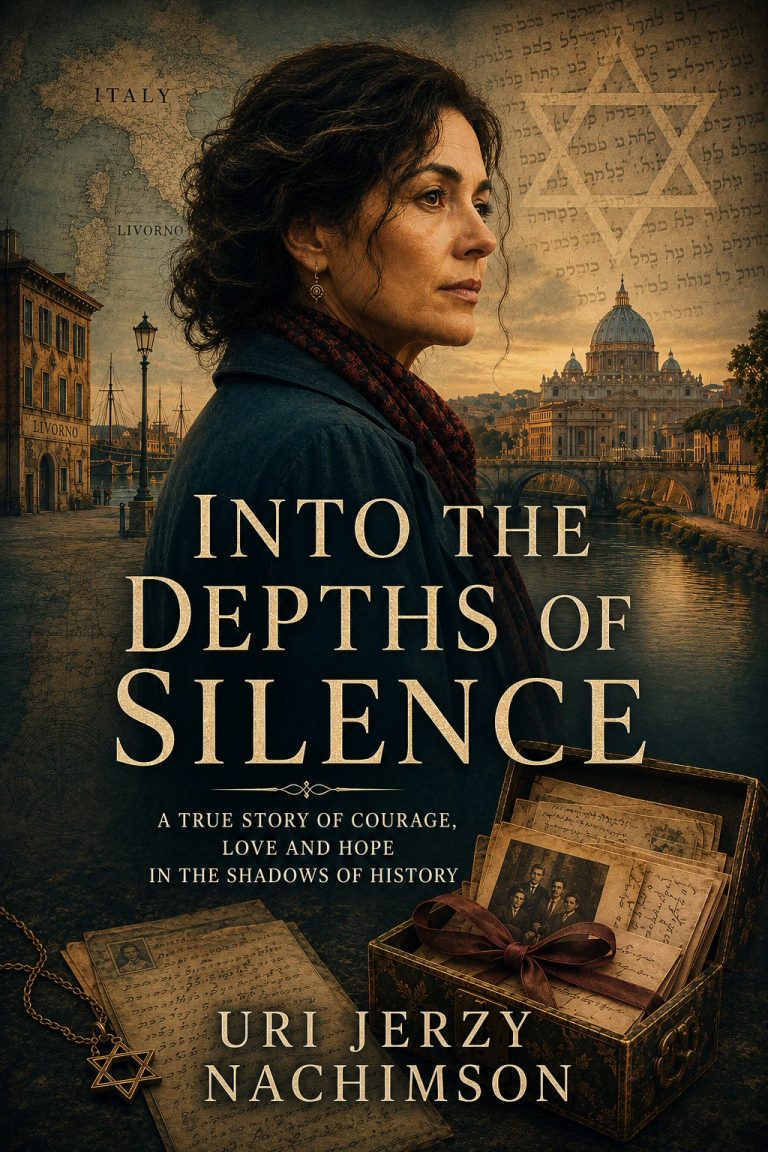
Long before I wrote the first sentence of Into the Depths of Silence, I already knew something my main character did not.
Beatrice was Jewish.
She had no idea. Her family had kept the truth hidden for generations. My task as a novelist was not to invent that truth, but to reveal it gradually, allowing Beatrice—and the reader—to discover it together.
That was the true beginning of this novel.
The origins of the book, however, go back much further than the day I sat down to write. They are rooted in a lifelong journey of memory, research, and personal curiosity.
I was born in Poland and immigrated to Israel with my parents when I was only eighteen months old. Although my family had been secular for generations, Jewish history and the Holocaust were always part of my world. My father lost almost his entire family during the Second World War, yet he never raised me to hate. On the contrary, he taught me that history must be understood without blaming entire nations for the crimes of individuals.
That lesson has remained with me throughout my life.
Over the years, I became increasingly fascinated by my family’s history and by the story of the Jewish people in Europe. This interest led me to write The Polish Patriot, the true story of my father, a physician and military officer during the war. Later came Lilly’s Album, followed by Identity, a deeply personal account of my search for my own family roots in Poland.
But the idea for Into the Depths of Silence was born in Italy.
For nearly twenty years I have lived in Tuscany with my Dutch wife and our youngest son. From there I began exploring the history of Jewish communities throughout Italy. I did not want to rely only on books and archives. I wanted to stand in the places where history had unfolded.
I visited the synagogues of Livorno, Florence, Siena, and Padua. I stood inside the ancient mikveh of Venice, where generations of Jews once gathered. I traveled through Sicily, tracing the remnants of communities that disappeared after the expulsion of the Jews from Spain. I visited Pitigliano, once known as “Little Jerusalem,” where the synagogue, the ritual bath, and the kosher wine cellar still bear witness to a remarkable Jewish past.
Yet the place that moved me most was much closer to home.
In the small Tuscan town of Monte San Savino, only a short distance from where I live, an ancient Jewish cemetery was rediscovered. Schoolchildren participating in archaeological work helped uncover gravestones that had remained hidden for centuries.
Standing there, I realised that history is not confined to books. It lives beneath our feet, inside forgotten buildings, ancient cemeteries, and silent streets. Sometimes it simply waits for someone willing to uncover it.
That experience changed the way I looked at Italy.
During my research, I became deeply interested in the historical journey of the Jewish people across the Mediterranean. Historical evidence shows that after the destruction of the Second Temple, many Jews were deported to different parts of the Roman Empire, including southern Italy and Sicily. Centuries later, more Jewish families arrived after being expelled from Spain and Portugal.
These historical facts formed the foundation of my novel.
But history alone does not create fiction.
One day I asked myself a simple question:
What would happen if an Italian woman suddenly discovered that her family had hidden a Jewish past for generations?
From that question, Beatrice was born.
I deliberately chose a woman as my protagonist because most of the central characters in my novels are women. I believe they often express the struggle between past and present with remarkable emotional depth.
Beatrice lives in Rome and believes she knows who she is.
She doesn’t.
I knew her secret from the very beginning.
She had to discover it herself.
In many families, especially in Europe, difficult chapters of history have remained unspoken for decades. Not because people wished to deceive their children, but because silence often seemed easier than remembering.
I wanted to explore what happens when silence finally ends.
The novel itself was written in an unusual way. Every night, after the house had become quiet, I would lie in bed with my iPad and write one chapter after another. Night after night, over several months, the story slowly unfolded.
By the time I reached the final chapter, I realised that Beatrice’s journey was not only about discovering her family’s past.
It was about discovering herself.
That is why I chose the title Into the Depths of Silence.
The silence in this novel is not merely personal.
It is the silence of forgotten families.
The silence surrounding the Inquisition.
The silence left behind by the Holocaust.
And the silence that often hides the truth until someone has the courage to ask one more question.
My intention was never to persuade anyone to change their identity or beliefs.
Quite the opposite.
I believe every person has the right to know where they come from. Understanding one’s roots does not change who we are, it helps us understand ourselves more deeply.
Perhaps that is also why I wanted this novel to appear in German.
For me, translation is not only about language.
It is about dialogue.
A dialogue between generations.
Between history and the present.
Between memory and hope.
If there is one thought I hope readers will carry with them after closing this novel, it is this:
Every family has a story.
Some stories are told openly.
Others remain hidden for generations.
Sometimes all it takes is one person willing to ask one more question for the silence to begin to break.
Uri Jerzy Nachimson